If you've watched even a small amount of television in your life, you realize that when the announcer begins by saying, "Tonight... on a very special episode of Punky Brewster" or "Full House" or whatever show you're watching, you know that in this episode someone is either going to a) die, b) be tempted to smoke, drink, take drugs or have sex or c) run away from home. Well, tonight nobody here is dying. There is no alcohol and there will be none of the other recreational activities here at Attention Span. That leaves us with (c).
I'm not going to talk about kids running away from home. My focus is on Christians who run away from the church. And also those who never were in the church to begin with. I'd like to know why.
I can see many, many faults and problems with the church, and I'm wondering what can be done to correct them. I'm preparing a series of posts called, "What's Wrong With Church?" and I'd like your input. Whether you love the local church or you just can't stand the church, I would like to have your answers to this question:
What are the top three problems of the local church today?
I have my own ideas, but I'd love your perspective. So please leave a comment. If you can't figure out how to comment, use my email contact link. And look for "What's Wrong With Church? - The Series" next week.
Tuesday, February 28, 2006


Firefox Friendly Phase Duh
Alright, this time it should work for everyone. I downloaded Firefox and found the problem with the old template just as Lauren and Carol reported. The odd thing is that I had the exact same template at my test site and had no problems with it there in IE or in Firefox. After doing a line-by-line code comparison, I decided to reload the template and try again. This time I changed it to tan/brown just for a change of pace. I think all the bells, whistles and links are proper once again. If you have any problems, either email me or drop me a comment here. Thanks.
Monday, February 27, 2006
The Filth Within


It's a classic gag. The ol' fly in the ice cube trick. Your victim thinks she is enjoying a cold, refreshing glass of lemonade, but when she is half-finished with her drink.... AHHHH! One of the ice cubes contains a housefly, frozen inside! Oh, the humanity! Her lips must have brushed up against the ice which entombed this small insect! The horror!
After the laughing subsides, you then pull out the "ice cube" to show her that it was all a practical joke. It's not a real ice cube at all. It's simply a plastic novelty item, approximately on par with the whoopie cushion and the fake doggie doo.
Of course, the terrorlies in the fact that there are all kinds of disgusting things out there. We don't want to eat flies or have our lips brush against one. But at least with the "ice cube" you can see the filth before you try to eat the filth. We can identify the housefly as repulsive and avoid it. But what about the filth we can't see?
A tip of the ol' ballcap to Mark of runalong with pastor mark fame for directing my attention to this science fair project in South Florida, where a twelve year old girl, who was annoyed at the way her friends would chew the ice from their fountain soft drinks, decided to check to see what was in that ice. She collected ice from self-serve fountains inside fast food restaurants and compared them to... (you may want to skip the rest of this paragraph. Really. Well, OK, but don't say I didn't warn you.) ...she compared the ice in the restaurant to water she collected from the toilets in these restaurants! The story doesn't tell us if she collected the water from the tank or from the bowl, but I doubt we really want that much information now, do we? And the results? You guessed it. Seventy percent of the time, ice from fast food restaurants was dirtier than toilet water. In several cases, the ice tested positive for E. coli bacteria, which comes from human waste and is much sneakier than the ol' fly in the ice cube.
Even if you can't see it, oftentimes filth is there. It doesn't have to be huge and obvious "frozen housefly" filth. The microscopic filth is bad enough. Worse maybe.
Yet we all have filth within. That's what human depravity really means. This side of heaven, we aren't going to be E. coli free, to coin a phrase. Not you. Not me. And I'm fascinated that some people really don't get that. I'm not proud of the fact that I sin, but I do. And it happens every single day. And (gasp!) I'm a pastor. But we pastors are depraved as well.
Chad from Eternal Revolution posted on this same subject as I was preparing this post. He pointed me to this story about a pastor in North Carolina who dares to admit to his congregation that he struggles with tithing the way the people in the pews do. That pastor said this about being a pastor:
You are held to a higher standard... People want their pastors (always) to be kind, peaceful and in touch with God... I see myself ordained to certain tasks of ministry. But I really do try to say all the time that I am just a human being. I am just as sinful as anyone else.Chad also pointed out another blog where the same article is referenced, but the discussion there is that it is terrible that pastors will admit to sinning. The majority of commenters seemed to be appalled by the notion of a pastor talking about his own battles with sin. Like this poster:
If the pastor/elder is teaching the Word of God faithfully, then it is Jesus preaching. Romans 8:29 says that those whom the Father "foreknew", are predestined to be conformed to the image of His Son. That would be Jesus,...no? Setting Jesus apart as an unattainabble standard is the essence of post-modern theology.What kind of warped theology is this? Perfection is not going to happen in our lifetime. Perfection happens at glorification -- when we go to heaven. No living man, woman, preacher, blog commenter or anyone else has hit complete holiness. Yes, Jesus is the unattainable standard while we are in this sphere. And to pretend otherwise contradicts Scripture. A pastor does not become Jesus when he preaches. I am guided by the Holy Spirit when I am behind the pulpit, but that doesn't mean I cannot or have not made a mistake. As pastors, we are not 100% holy. We are not 100% faithful in teaching. We are not 100% filth free. That's why we Christians are called to check out what the preacher is saying, as the Bereans did with Paul.
The admissions can go too far. I certainly don't need to hear an accounting of the various struggles a pastor has with improper sexual fantasies. I don't want a play-by-play recap of his battle with homosexuality. I don't even want a pastor's details about why he can't stand his neighbor. But by the same token, to pretend that there is no human depravity taking its toll every single day is living a lie. This pastor's open admission and acknowledgement of a battle with selfishness is not an assault on a perfect pastorate. There has never been a perfect pastor. There has always been filth within, despite the struggles to overcome.
We do not like the fact that in any of us, there is filth. Yet selfishness, greed, lust, sloth and all their cousins are semi-permanent residents within us. Today there are saints and sinners everywhere, but even when we are saints, still we are sinners. Even when the sins are not "frozen housefly" size, they are just as deadly. But to pretend they are not there is deadlier.
So praise God for the atoning blood of Christ. That filth isn't coming out of there any other way.
Saturday, February 25, 2006
For All You Firefox Lovers
This should be better. Many people were having problems getting the blog to load correctly while using Firefox with the old template. Then lately some of the rest of us were having problems getting the page to load... period. So, I've gone back to the blue template from last summer for the time being. I always liked this one anyway.
For those of you disturbed people who were asking me to put my picture back up (for use in repelling insects and killing small rodents), here you go.
I'm sure I'll change it again in a month or two, but I'll do a little more testing before I subject the rest of you to my bizarre experimentation. I promise.
Fair warning: a new post is coming this weekend, but you might not want to have a soft drink from a fast food place beside you when you read it...
For those of you disturbed people who were asking me to put my picture back up (for use in repelling insects and killing small rodents), here you go.
I'm sure I'll change it again in a month or two, but I'll do a little more testing before I subject the rest of you to my bizarre experimentation. I promise.
Fair warning: a new post is coming this weekend, but you might not want to have a soft drink from a fast food place beside you when you read it...
Thursday, February 23, 2006
OT Ignorance
Aweek or two ago, I was discussing something at another blog when I brought up the fact that I hadn't read the book of Nahum for a long time. Truth be told, I've probably only read Nahum twice in my life, both times while I read through the Bible systematically. I knew the basics about the book -- it was an oracle against Nineveh and the Assyrians some time after that city-state had repented after heeding the warning from Fish Food Jonah. This time there was no repentance and soon there would be no Nineveh either. However I hadn't actually read the words for years. Two bloggers challenged me to read it. Actually they challenged me to preach a sermon for each of the 47 verses of the book, but that's just insanity! But since I'm in the midst of a through-the-Bible reading program (follow my progress here), I skipped ahead to read Nahum again.
I'd love to be able to write that Nahum changed my life. But I can't. It was an interesting read. The vividness of the prophecy is almost chilling. But was I instantly conformed to the image of Christ after reading it? No. I was enriched, but not overwhelmed.
A few weeks ago, I stumbled across a poster who asked why pastors never seemed to preach at length from the Old Testament. The Christmas Narratives, the Passion, Romans, the Sermon on the Mount... all these are "old favorites" for pulpit-dwellers. But Judges? Ezekiel? Nahum? Aside from a rare cameo verse, those books are hardly ever preached. The blogger wondered why that was? With all the richness of the Old Testament texts, why do pastors return to the Prodigal Son and the Romans Road time and again?
My response was pretty simple. Pastors don't preach the Old Testament because far too many don't know the Old Testament. We preachers enjoy working through the parables or mapping out Paul's missionary journies, but Isaiah is tough stuff to understand, let alone teach! Like everyone else, we get caught up in the idea that studying the New Testament is good use of our time and studying the Old Testament is something that is... well, time consuming and not too applicable to everyday life. And generally speaking, we're just plain wrong about that.
Jesus sure had a healthy respect for what we know today as the Old Testament. These 37 books give us the background which bring the Master's teachings new light. Not each will keep us riveted, perched on the edge of our seats, awaiting the next essential truth to fall from its pages. However being ignorant of these writings make it tough to really get the message of the New Testament.
We all tend to look at the Old Testament differently than we do the New. God seems so harsh at times. Everything is built around a nation of people which is foreign to us. So many of the pages are clogged with genealogies, strange laws and obscure prophecy. But it is here that we are given our initial glimpses of our Creator. It is here that the plan of salvation is foreshadowed. It is here that we see the ups and downs of real people trying to follow God. And it is here where we find the Law which we can never hope to keep perfectly. As Paul wrote, that Law was to drive us to Christ. But that's New Testament stuff. You probably knew that already.
I was amused last week to read the comments of Ralph that Genesis is the most read book of the Bible. The truth is that most of us feel really strange rifling through the Old Testament because we don't ever read it. We can find Psalms. After all it's in the middle of the book, right? But which comes first 1 & 2 Kings or 1 & 2 Chronicles? Is Nehemiah before Daniel or after? Is Obadiah before or after Nahum? And what about the book of Hezekiah?
So pick up your Old Testament. Deal with names like Jephthah and Nimrod. Work with places named Timnath Serah and Bezer. And revel in the faith of Abraham, the rise and fall of Solomon, the hardships of Isaiah and Hosea, the triumphs of Moses and Elijah, and the life of a man after God's own heart. Don't be ignorant of what God made sure was preserved for our benefit.
And if you're still looking for the book of Hezekiah, you can stop now.
I'd love to be able to write that Nahum changed my life. But I can't. It was an interesting read. The vividness of the prophecy is almost chilling. But was I instantly conformed to the image of Christ after reading it? No. I was enriched, but not overwhelmed.
A few weeks ago, I stumbled across a poster who asked why pastors never seemed to preach at length from the Old Testament. The Christmas Narratives, the Passion, Romans, the Sermon on the Mount... all these are "old favorites" for pulpit-dwellers. But Judges? Ezekiel? Nahum? Aside from a rare cameo verse, those books are hardly ever preached. The blogger wondered why that was? With all the richness of the Old Testament texts, why do pastors return to the Prodigal Son and the Romans Road time and again?
My response was pretty simple. Pastors don't preach the Old Testament because far too many don't know the Old Testament. We preachers enjoy working through the parables or mapping out Paul's missionary journies, but Isaiah is tough stuff to understand, let alone teach! Like everyone else, we get caught up in the idea that studying the New Testament is good use of our time and studying the Old Testament is something that is... well, time consuming and not too applicable to everyday life. And generally speaking, we're just plain wrong about that.
Jesus sure had a healthy respect for what we know today as the Old Testament. These 37 books give us the background which bring the Master's teachings new light. Not each will keep us riveted, perched on the edge of our seats, awaiting the next essential truth to fall from its pages. However being ignorant of these writings make it tough to really get the message of the New Testament.
We all tend to look at the Old Testament differently than we do the New. God seems so harsh at times. Everything is built around a nation of people which is foreign to us. So many of the pages are clogged with genealogies, strange laws and obscure prophecy. But it is here that we are given our initial glimpses of our Creator. It is here that the plan of salvation is foreshadowed. It is here that we see the ups and downs of real people trying to follow God. And it is here where we find the Law which we can never hope to keep perfectly. As Paul wrote, that Law was to drive us to Christ. But that's New Testament stuff. You probably knew that already.
I was amused last week to read the comments of Ralph that Genesis is the most read book of the Bible. The truth is that most of us feel really strange rifling through the Old Testament because we don't ever read it. We can find Psalms. After all it's in the middle of the book, right? But which comes first 1 & 2 Kings or 1 & 2 Chronicles? Is Nehemiah before Daniel or after? Is Obadiah before or after Nahum? And what about the book of Hezekiah?
So pick up your Old Testament. Deal with names like Jephthah and Nimrod. Work with places named Timnath Serah and Bezer. And revel in the faith of Abraham, the rise and fall of Solomon, the hardships of Isaiah and Hosea, the triumphs of Moses and Elijah, and the life of a man after God's own heart. Don't be ignorant of what God made sure was preserved for our benefit.
And if you're still looking for the book of Hezekiah, you can stop now.
Wednesday, February 22, 2006
How To Get Here Again
I never figured this would become a weekly feature, but the weird search strings keep rolling in. People actually searched for these:
Goofy Biblical Admonitions - Ah, from the Gospel According to Disney.
example of a distorted sense of self - Hey! You're gettin' a little personal, aren't ya'?
stomach virus fort wayne indiana message boards - I can only imagine what the topics of discussion are on those boards! "Where to buy Pepto-Bismal on the east side," and "Best places in town to vomit."
how to fix ghost span segment bad - I'm confused. Fix it bad? What's a ghost span? Why is it in segments? Who broke it? Why is it bad? And what does this mean??!!
motocross rider's average salary - I'm not sure, but I'm betting it speeds by my weekly paycheck.
in the sport of curling, what's the meaning of the term "hammer" - Hammer? Hammer? You're lucky I know what curling is! All I can tell you is, "U Can't Touch This."
And there is the direct method... click the link on my post at Christian Carnival CX which is posted now over at Jordan's View.
Goofy Biblical Admonitions - Ah, from the Gospel According to Disney.
example of a distorted sense of self - Hey! You're gettin' a little personal, aren't ya'?
stomach virus fort wayne indiana message boards - I can only imagine what the topics of discussion are on those boards! "Where to buy Pepto-Bismal on the east side," and "Best places in town to vomit."
how to fix ghost span segment bad - I'm confused. Fix it bad? What's a ghost span? Why is it in segments? Who broke it? Why is it bad? And what does this mean??!!
motocross rider's average salary - I'm not sure, but I'm betting it speeds by my weekly paycheck.
in the sport of curling, what's the meaning of the term "hammer" - Hammer? Hammer? You're lucky I know what curling is! All I can tell you is, "U Can't Touch This."
And there is the direct method... click the link on my post at Christian Carnival CX which is posted now over at Jordan's View.
Call Me Irresponsible

It sure is easy to point fingers. For all the bad and nasty stuff I can complain about, I am seemingly blind to my part in it all. Even my attitude toward the people around me can make a difference in how they act. Lack of communication is a two-way problem. Bad behavior in others may be reduced if I give proper encouragement. Sure, sometimes it really is somebody else's fault. But I need to ask myself, "What can I do to help change the situation?" Time for me to take some responsibility... even if I don't think I need to.
(A tip of the ol' ballcap to Mark of runalong with pastor mark for the illustration.)
Tuesday, February 21, 2006
The Faith of Abednego
I am truly grateful that God was able to use my post When God Doesn't Heal to touch some hearts last week. That post was a tough one to write, partly because I can get quite angry with people who discount and denegrate the faith of someone who has cancer or is stuck in a wheelchair. But it was also difficult to express because there is a line which I do not want to cross. I do not want to give the impression that God doesn't still heal people divinely. I know it still happens. I've seen the results. And I don't in any way want people believing that God cannot do miracles. Nothing is impossible with God.
Over at Cerulean Sanctum, Dan, who is my brother in Christ Jesus, has commented that we must believe that God can do the miraculous, and I wholeheartedly agree. Dan and I simply differ on how much faith we have and how much faith we need. I maintain that Jesus told us we need just the amount as small as a mustard seed, which was the smallest seed known at that time. In other words, a little is powerful stuff.
A little bit of faith got Simon Peter out on the water for a little stroll. When he noticed the waves and it kicked into his head that he was doing the impossible, the doubts flooded in. Jesus allowed Peter to drop into the water and taught him a valuable lesson that God can do the impossible and that we should trust Him. He did not say that when our doubts creep in that he will no longer be our source of physical strength. In fact it should be noted that when Doubting Peter fell into the water, he cried for help to Jesus and it was Jesus who reached down and pulled him out again. Peter's faith had been weakened, but it was not gone.
I've already written at length about the people whom God chose not to heal. The Apostle Paul is the most glaring example because we even have Paul's account of God telling him "No". But let's remember that in no way and at no time did Paul ever not have faith that God could heal him. He could have. He didn't. And that is the most important distinction we can draw. I have much faith that God can do the impossible. I have faith that if I pray and it is God's will, that He will do the impossible. However I also know that sometimes God chooses not to do the impossible.
To the best of my knowledge, He has never answered a prayer to move a mountain into the sea in spite of the fact Jesus told us we could do that with the tiniest amount of faith. So why isn't Kilimanjaro in the middle of the Atlantic? It is not God's will. No matter how much faith we have, if God doesn't want it done, it will not be done. There are some extremists (and I am not including my friend Dan) who say that we must have faith that God can do the impossible, that God will do the impossible, and that if we ask it, that God must do the impossible. Nonsense. God doesn't take His marching orders from us. If we are not careful in our thinking that God will always heal, we can move into the mindset that we are entitled to that healing because of our faith. That simply isn't true. Ask Paul.
These extremists are the people who belittle the faith of the disabled and chide the cancer-ridden for a lack of belief. Those are the people who get my dander up. (Whatever that means.) I've already shown that healing is not guaranteed by Psalm 53:5. I've written about the need to be asking in Jesus' authority, that is in agreement with His will, when we pray. But what I want to make clear is that we must have faith that God can heal, even in the most desperate situation, but we must accept that God will not heal if He has something better for us in mind. That means "better" from His perspective, not our perspective. And I'll have faith in Him that He knows what is best.
What we are called to have is the faith of Abednego. And Shadrach. And Meshach. The text says they all spoke the words, but I doubt they said them in unison, so I'm making Abednego the spokesman for the group. What words? In Daniel 3:16-18. You remember the situation. Daniel's three friends are about to be thrown into the incinerator for not bowing down to worship the golden image as they were commanded. Nebuchadnezzar gives them one final chance to worship the idol or be burned alive. That's when Abednego and company pronounced their words of faith:
Shadrach, Meshach and Abednego knew the difference between faith that God can heal, faith that He will heal, and faith that He must heal. The lesson we must learn is that our faith should not suffer simply because God chooses not to answer our prayers for healing just as we ask. Believe that God can. Believe that if it is His will that He will. But never for a moment believe that He must. Only God is God.
Almighty God, give us the faith of Abednego.
Over at Cerulean Sanctum, Dan, who is my brother in Christ Jesus, has commented that we must believe that God can do the miraculous, and I wholeheartedly agree. Dan and I simply differ on how much faith we have and how much faith we need. I maintain that Jesus told us we need just the amount as small as a mustard seed, which was the smallest seed known at that time. In other words, a little is powerful stuff.
A little bit of faith got Simon Peter out on the water for a little stroll. When he noticed the waves and it kicked into his head that he was doing the impossible, the doubts flooded in. Jesus allowed Peter to drop into the water and taught him a valuable lesson that God can do the impossible and that we should trust Him. He did not say that when our doubts creep in that he will no longer be our source of physical strength. In fact it should be noted that when Doubting Peter fell into the water, he cried for help to Jesus and it was Jesus who reached down and pulled him out again. Peter's faith had been weakened, but it was not gone.
I've already written at length about the people whom God chose not to heal. The Apostle Paul is the most glaring example because we even have Paul's account of God telling him "No". But let's remember that in no way and at no time did Paul ever not have faith that God could heal him. He could have. He didn't. And that is the most important distinction we can draw. I have much faith that God can do the impossible. I have faith that if I pray and it is God's will, that He will do the impossible. However I also know that sometimes God chooses not to do the impossible.
To the best of my knowledge, He has never answered a prayer to move a mountain into the sea in spite of the fact Jesus told us we could do that with the tiniest amount of faith. So why isn't Kilimanjaro in the middle of the Atlantic? It is not God's will. No matter how much faith we have, if God doesn't want it done, it will not be done. There are some extremists (and I am not including my friend Dan) who say that we must have faith that God can do the impossible, that God will do the impossible, and that if we ask it, that God must do the impossible. Nonsense. God doesn't take His marching orders from us. If we are not careful in our thinking that God will always heal, we can move into the mindset that we are entitled to that healing because of our faith. That simply isn't true. Ask Paul.
These extremists are the people who belittle the faith of the disabled and chide the cancer-ridden for a lack of belief. Those are the people who get my dander up. (Whatever that means.) I've already shown that healing is not guaranteed by Psalm 53:5. I've written about the need to be asking in Jesus' authority, that is in agreement with His will, when we pray. But what I want to make clear is that we must have faith that God can heal, even in the most desperate situation, but we must accept that God will not heal if He has something better for us in mind. That means "better" from His perspective, not our perspective. And I'll have faith in Him that He knows what is best.
What we are called to have is the faith of Abednego. And Shadrach. And Meshach. The text says they all spoke the words, but I doubt they said them in unison, so I'm making Abednego the spokesman for the group. What words? In Daniel 3:16-18. You remember the situation. Daniel's three friends are about to be thrown into the incinerator for not bowing down to worship the golden image as they were commanded. Nebuchadnezzar gives them one final chance to worship the idol or be burned alive. That's when Abednego and company pronounced their words of faith:
Shadrach, Meshach and Abednego replied to the king, "O Nebuchadnezzar, we do not need to defend ourselves before you in this matter. If we are thrown into the blazing furnace, the God we serve is able to save us from it, and he will rescue us from your hand, O king. But even if he does not, we want you to know, O king, that we will not serve your gods or worship the image of gold you have set up."See that distinction? Our God is able to -- He can -- save us. He will rescue, but even if he does not... Wait! Is that a lack of faith? Of course not! Abednego and friends simply knew that sometimes God makes His point in other ways. We have no information that God disclosed any revelatory information to the three. They knew that God was able to save. They knew that if it was His will, he would save. But they also knew that God might have other plans, and they warned the king that even if God would let them burn to death, their faith in Him would not be diminished.
Shadrach, Meshach and Abednego knew the difference between faith that God can heal, faith that He will heal, and faith that He must heal. The lesson we must learn is that our faith should not suffer simply because God chooses not to answer our prayers for healing just as we ask. Believe that God can. Believe that if it is His will that He will. But never for a moment believe that He must. Only God is God.
Almighty God, give us the faith of Abednego.
Monday, February 20, 2006
It's Just a Game... or is it?
First -- it is a parody, so don't get wound up too tightly.
Second -- Yikes! It's surprisingly accurate!
Third -- Some mighty good points if you think about it.
(A tip of the ol' ballcap to Quotidian Grace.)
Second -- Yikes! It's surprisingly accurate!
Third -- Some mighty good points if you think about it.
(A tip of the ol' ballcap to Quotidian Grace.)
Arguing with a Fool
I spend time at a forum for race fans. Mostly the talk is about the Indianapolis 500 and open wheel racing, but we have a separate forum set up to discuss and argue current events. Much of the talk ends up as political rhetoric, and I don't get too involved unless somebody posts something really outlandish. But every once in a while a religious topic gets started. We had one of these late last week with people expressing strong opinions about Christianity promoting a "dumbed-down" version of science. It was a ridiculous complaint, but in itself the original debate was no big deal. However, as happens in many discussions, the topic began to scatter in a few different directions.
Many of the new directions were begun because of a poster I'll call "Ralph" who is very antagonistic toward Christianity. It was also quite apparent that Ralph didn't have much of a grasp of the basics of Christianity. His posts read like he had just heard something from a friend of his, or had found some extremist website to quote.
The folks at the racing forum know that I'm a pastor. A few people can't stand religion, Christ, God or any words which remind them of any deity. That really doesn't bother me. In real life, I probably would just ignore folks like Ralph -- well, not ignore him, but I wouldn't bother to try to "straighten him out" or anything similar. But an internet forum comes complete with an audience. There are posters and surfers alike who could read one of Ralph's ridiculous assertions and actually believe it. So I make it a point to at least give the other side of the story.
After a while, though, the debate gets boring. There is only so long I can stay interested in rebutting the arguments of someone who is not only misinformed, but also is making little sense. When Ralph mentioned people not reading the Bible all the way through from Genesis to Acts (yes, he thought Acts was the last book of the Bible!) I suggested that he really didn't know as much as Christianity as he thought, so perhaps he should check his facts before he makes a post. His defense missed the point entirely.
The argument has subsided now. The outlandish claims about Christians have ceased for the time being. And I realize that I did what I had to do. But the whole process got me thinking. Have I ever been guilty of shooting my mouth off out of ignorance? Have I repeated something I have heard without checking it out first? In short, am I guilty of doing the same thing I found so frustrating and amusing in Ralph?
Of course, I'm guilty. I've trusted people who were actually not that trustworthy. And I've passed along information that I accidentally distorted along the way -- a faulty attention span and bad hearing help. There have been times when people who were debating with me were actually arguing with a fool. That's a shame. I know better. To pass along some information is simply gossip. To not check the facts is simply lazy.
"Lord I pray that You will continually remind me not to be a fool when I'm supposed to be representing You."
Many of the new directions were begun because of a poster I'll call "Ralph" who is very antagonistic toward Christianity. It was also quite apparent that Ralph didn't have much of a grasp of the basics of Christianity. His posts read like he had just heard something from a friend of his, or had found some extremist website to quote.
The folks at the racing forum know that I'm a pastor. A few people can't stand religion, Christ, God or any words which remind them of any deity. That really doesn't bother me. In real life, I probably would just ignore folks like Ralph -- well, not ignore him, but I wouldn't bother to try to "straighten him out" or anything similar. But an internet forum comes complete with an audience. There are posters and surfers alike who could read one of Ralph's ridiculous assertions and actually believe it. So I make it a point to at least give the other side of the story.
After a while, though, the debate gets boring. There is only so long I can stay interested in rebutting the arguments of someone who is not only misinformed, but also is making little sense. When Ralph mentioned people not reading the Bible all the way through from Genesis to Acts (yes, he thought Acts was the last book of the Bible!) I suggested that he really didn't know as much as Christianity as he thought, so perhaps he should check his facts before he makes a post. His defense missed the point entirely.
The argument has subsided now. The outlandish claims about Christians have ceased for the time being. And I realize that I did what I had to do. But the whole process got me thinking. Have I ever been guilty of shooting my mouth off out of ignorance? Have I repeated something I have heard without checking it out first? In short, am I guilty of doing the same thing I found so frustrating and amusing in Ralph?
Of course, I'm guilty. I've trusted people who were actually not that trustworthy. And I've passed along information that I accidentally distorted along the way -- a faulty attention span and bad hearing help. There have been times when people who were debating with me were actually arguing with a fool. That's a shame. I know better. To pass along some information is simply gossip. To not check the facts is simply lazy.
"Lord I pray that You will continually remind me not to be a fool when I'm supposed to be representing You."
Sunday, February 19, 2006
Random Thoughts on a Sunday Night
Why is it that male ice dancers feel the need to wear a plunging neckline on their little jumpsuits? I'm old enough to remember disco. I don't need the flashbacks, thank you very much.
Can a person go out and buy a bobsled somewhere?
Would someone please go out and get Steve some coffee?!?!
It appears to me that fans of a sport watch for the skill and artistry while interested bystanders watch to see people crash. Funny thing, most of the Daytona 500 highlights are the crashes. Same could be said for figure skating and short track speed skating.
Why is it that John from Locusts and Honey can mention that I deserve a monthly column in Christianity Today and six people come to check out my post, but when he mentions that I wrote about "size matters" I get almost 50 hits?
How nuts do you have to be to cross country ski?
I purposely left my post, "When God Doesn't Heal" at the top of the blog all weekend. It generated only two comments on the site, but the private emails have been enlightening. It's amazing the people who have been told they don't have enough faith. Forgive me for not answering all of you.
I had a guy try to tell me that Genesis was the most read book of the Bible. I wouldn't even put Genesis in the top ten. In fact the only Old Testament book would probably be Psalms. What do you think? Which book of the Bible is the most read?
Can a person go out and buy a bobsled somewhere?
Would someone please go out and get Steve some coffee?!?!
It appears to me that fans of a sport watch for the skill and artistry while interested bystanders watch to see people crash. Funny thing, most of the Daytona 500 highlights are the crashes. Same could be said for figure skating and short track speed skating.
Why is it that John from Locusts and Honey can mention that I deserve a monthly column in Christianity Today and six people come to check out my post, but when he mentions that I wrote about "size matters" I get almost 50 hits?
How nuts do you have to be to cross country ski?
I purposely left my post, "When God Doesn't Heal" at the top of the blog all weekend. It generated only two comments on the site, but the private emails have been enlightening. It's amazing the people who have been told they don't have enough faith. Forgive me for not answering all of you.
I had a guy try to tell me that Genesis was the most read book of the Bible. I wouldn't even put Genesis in the top ten. In fact the only Old Testament book would probably be Psalms. What do you think? Which book of the Bible is the most read?
Friday, February 17, 2006
When God Doesn't Heal
When someone is sick, I pray for healing. Sometimes it happens. Sometimes it doesn't. I can deal with that. After all, God is sovereign, and He has a much better perspective on what is best in each individual sitution than I could ever hope for. What I can't deal with are the folks on either extreme who claim that it is always God's will to heal and their counterparts who never really come out and say that God doesn't do healings anymore, but that's the way they pray. Those in the latter category I'll let off easy today. Dan at Cerelean Sanctum has already posted a great piece about the need to believe that Jesus really can still heal. Besides, I think those who really don't think God ever heals are suffering from a bigger problem -- a very superficial relationship with their Creator.
But on the other end of the spectrum, I've encountered some people who have actually claimed that God will always heal, if we have the faith. I've found that attitude rather sad. Allow me to steal this story from Pastor Jon's Blog. A lady called into a radio "ask the pastor" talk show.
How insulted suffering folks have been from well-meaning, but ill-informed Christians like these. The arguments they give me are interesting but are drawn from an incomplete look at Scripture and the evidence surrounding us.
First, they say the Jesus didn't turn away anyone who needed healing. And to the best of my knowledge that is correct. In all the time Jesus walked the earth, I see no instance of Jesus turning down someone who asked for healing. The exception of course is that Jesus didn't do miracles where people had no faith in Him. Again, that point is granted. But to make a blanket statement from this argument ignores the times when the post-ascension Jesus did not heal. Paul's thorn in the flesh of 2 Corinthians is a prime example. So is Timothy and his stomach problems. And we could also go further and mention that within the time frame of the New Testament, John the Baptist and James, the son of Zebedee were each executed. Why didn't God intervene in any of these situations?
Paul tells us that he was given that thorn to keep him from getting a big head about all the special revelation he had been given. When he prayed (three times) for it to be taken away, he was told that God's grace was sufficient -- healing wasn't necessary. Now if God's grace is enough and thorns are given to teach in Paul's case, why would we think that we need more than God's grace? Do we not need to learn? Is the example of the refiner's fire, burning out impurities, irrelevent to our lives today? Of course not. Our suffering serves a purpose for our good. Our ultimate healing isn't the point. Our changed lives will bring glory to God.
Common sense tells us that we're all going to die. Many of us will die of a sickness or a disease. We are not plucked from the earth like Enoch or driven off in a fiery chariot like Elijah. Sometimes our sicknesses accomplish our exit from this world and entrance into the next. And thank God they do!
I have been told that healing is provided for in the atonement -- that is, that when Jesus died, He bore the punishment for our sins as well as our sickness on the cross. The proof text Isaiah 53:5 is often tossed at me, "By His stripes we are healed." But a closer look at the context shows that the prophet is speaking in parallel lines. The first two lines of verse 5 refer to Jesus' physical sufferings and our physical sins. These next two lines deal with Jesus' physical punishment and our spiritual state.
Besides, if we were physically healed by Jesus' wounds, why would we ever get sick in the first place?
What about where James tells us:
But if we look carefully at passages like John 14:12-14, we see that we are to be asking things "in my(Jesus') name" for our prayers to be answered as we wish. The phrase "in Jesus' name" is not a magic spell to be uttered for a prayer to work. It means that we pray in the authority of Jesus. So our prayer -- whether for a blessing, a gift or a healing -- must be in accordance with His will if God is going to answer it. The two or three of us on earth must agree with God's will in the situation. God will not grant our prayer if it contradicts His will.
If one takes the position that it is always God's will to heal, one must also fall back on the excuse that anyone not healed lacks sufficient faith. Yet at the same time, Jesus tells us that even faith the size of a mustard seed, which was the smallest seed known by that generation, is enough to move a mountain into the sea. So how small must a believer's faith be if he or she is not healed? It must not exist! Or if it does, it is small enough to be negligible. And realize that nobody is throwing mountains into the sea because it is obviouly not God's will.
Now, let's get back to the obviously-not-faith-decificent apostle Paul. Or maybe Timothy. Is anyone going to seriously float the idea that either of these two didn't have faith the size of a mustard seed? Alright, what about modern folks? Joni Erickson Tada was paralyzed in an accident as a teenager. She prayed in faith many, many times, and has written about those experiences. So why is she still in a wheelchair? Why does Billy Graham have Parkinson's? Why do men and women of God wear glasses or walk with canes? Why do some faith healers wear toupees (and bad ones at that!)? Without enough faith?
A few years ago, my aunt died after a five-year struggle with lymph cancer. During the struggle, this woman with faith larger than a mustard seed was anointed and prayed for by the elders of the church, as called for in James. Cancer still took her. A lady in my church is now fighting the same type of battle. So are another dozen acquaintances. My neighbor was called home on New Year's Eve. He was never healed of his cancer.
Most everyone reading this could start a list like this of people of faith who have not been healed or died of their sickness. Yet instead of learning from Scripture, a few would rather tell these people they are "lacking in faith" -- almost accusing them of not being saved at all. How very sad. It is always easier to see the faults of others than to rightly understand that God doesn't always heal. Hopefully it won't take a whack to the head with a blind lady's white cane for these to see how God is glorified through the healthy and the sick, the blind and the seeing, the deaf and the hearing. God is glorified by healing, sure, and I've seen it happen. But God is also glorified through a life well-lived in spite of debilitating injury or a damaging illness. I know that I am inspired by a Christian whose faith is not destroyed even if their normal "healthy" body is. Praise God that He is thus glorified!
UPDATE! See also The Faith of Abednego for more thoughts on this subject.
But on the other end of the spectrum, I've encountered some people who have actually claimed that God will always heal, if we have the faith. I've found that attitude rather sad. Allow me to steal this story from Pastor Jon's Blog. A lady called into a radio "ask the pastor" talk show.
The lady, who was obviously crying, said, "Pastor, I was born blind, and I've been blind all my life. I don't mind being blind but I have some well meaning friends who tell me that if I had more faith I could be healed."
The pastor asked her, "Tell me, do you carry one of those white canes?"
"Yes I do," she replied.
"Then the next time someone says that hit them over the head with the cane," He said. "Then tell them, 'If you had more faith that wouldn't hurt!'"
How insulted suffering folks have been from well-meaning, but ill-informed Christians like these. The arguments they give me are interesting but are drawn from an incomplete look at Scripture and the evidence surrounding us.
First, they say the Jesus didn't turn away anyone who needed healing. And to the best of my knowledge that is correct. In all the time Jesus walked the earth, I see no instance of Jesus turning down someone who asked for healing. The exception of course is that Jesus didn't do miracles where people had no faith in Him. Again, that point is granted. But to make a blanket statement from this argument ignores the times when the post-ascension Jesus did not heal. Paul's thorn in the flesh of 2 Corinthians is a prime example. So is Timothy and his stomach problems. And we could also go further and mention that within the time frame of the New Testament, John the Baptist and James, the son of Zebedee were each executed. Why didn't God intervene in any of these situations?
Paul tells us that he was given that thorn to keep him from getting a big head about all the special revelation he had been given. When he prayed (three times) for it to be taken away, he was told that God's grace was sufficient -- healing wasn't necessary. Now if God's grace is enough and thorns are given to teach in Paul's case, why would we think that we need more than God's grace? Do we not need to learn? Is the example of the refiner's fire, burning out impurities, irrelevent to our lives today? Of course not. Our suffering serves a purpose for our good. Our ultimate healing isn't the point. Our changed lives will bring glory to God.
Common sense tells us that we're all going to die. Many of us will die of a sickness or a disease. We are not plucked from the earth like Enoch or driven off in a fiery chariot like Elijah. Sometimes our sicknesses accomplish our exit from this world and entrance into the next. And thank God they do!
I have been told that healing is provided for in the atonement -- that is, that when Jesus died, He bore the punishment for our sins as well as our sickness on the cross. The proof text Isaiah 53:5 is often tossed at me, "By His stripes we are healed." But a closer look at the context shows that the prophet is speaking in parallel lines. The first two lines of verse 5 refer to Jesus' physical sufferings and our physical sins. These next two lines deal with Jesus' physical punishment and our spiritual state.
Unless we somehow believe that our life is all peace, we have to see this as a spiritual peace between perfect Judge God and dirty sinners Us. So the parallelism tells us that we are dealing with a physical punishment to bring about a spiritual peace and a spiritual healing. Nothing about this verse promises us a life free from sickness if we have the faith.But he was pierced for our transgressions,
he was crushed for our iniquities;
the punishment that brought us peace was upon him,
and by his wounds we are healed.
Besides, if we were physically healed by Jesus' wounds, why would we ever get sick in the first place?
What about where James tells us:
Is any one of you sick? He should call the elders of the church to pray over him and anoint him with oil in the name of the Lord. And the prayer offered in faith will make the sick person well; the Lord will raise him up. If he has sinned, he will be forgiven.It sounds pretty straightforward. However, so does this passage:
Again, I tell you that if two of you on earth agree about anything you ask for, it will be done for you by my Father in heaven.
But if we look carefully at passages like John 14:12-14, we see that we are to be asking things "in my(Jesus') name" for our prayers to be answered as we wish. The phrase "in Jesus' name" is not a magic spell to be uttered for a prayer to work. It means that we pray in the authority of Jesus. So our prayer -- whether for a blessing, a gift or a healing -- must be in accordance with His will if God is going to answer it. The two or three of us on earth must agree with God's will in the situation. God will not grant our prayer if it contradicts His will.
If one takes the position that it is always God's will to heal, one must also fall back on the excuse that anyone not healed lacks sufficient faith. Yet at the same time, Jesus tells us that even faith the size of a mustard seed, which was the smallest seed known by that generation, is enough to move a mountain into the sea. So how small must a believer's faith be if he or she is not healed? It must not exist! Or if it does, it is small enough to be negligible. And realize that nobody is throwing mountains into the sea because it is obviouly not God's will.
Now, let's get back to the obviously-not-faith-decificent apostle Paul. Or maybe Timothy. Is anyone going to seriously float the idea that either of these two didn't have faith the size of a mustard seed? Alright, what about modern folks? Joni Erickson Tada was paralyzed in an accident as a teenager. She prayed in faith many, many times, and has written about those experiences. So why is she still in a wheelchair? Why does Billy Graham have Parkinson's? Why do men and women of God wear glasses or walk with canes? Why do some faith healers wear toupees (and bad ones at that!)? Without enough faith?
A few years ago, my aunt died after a five-year struggle with lymph cancer. During the struggle, this woman with faith larger than a mustard seed was anointed and prayed for by the elders of the church, as called for in James. Cancer still took her. A lady in my church is now fighting the same type of battle. So are another dozen acquaintances. My neighbor was called home on New Year's Eve. He was never healed of his cancer.
Most everyone reading this could start a list like this of people of faith who have not been healed or died of their sickness. Yet instead of learning from Scripture, a few would rather tell these people they are "lacking in faith" -- almost accusing them of not being saved at all. How very sad. It is always easier to see the faults of others than to rightly understand that God doesn't always heal. Hopefully it won't take a whack to the head with a blind lady's white cane for these to see how God is glorified through the healthy and the sick, the blind and the seeing, the deaf and the hearing. God is glorified by healing, sure, and I've seen it happen. But God is also glorified through a life well-lived in spite of debilitating injury or a damaging illness. I know that I am inspired by a Christian whose faith is not destroyed even if their normal "healthy" body is. Praise God that He is thus glorified!
UPDATE! See also The Faith of Abednego for more thoughts on this subject.
Thursday, February 16, 2006
Good Reads - 2/16/06
I know the Carnival is up and there's plenty to read there, but here are some posts I can recommend for your intellectual and not-that-intellectual stimulation:
I'll begin with what is quite simply a must-read, especially if you are fighting or know someone who is fighting cancer. Written by John Piper on the eve of his prostate cancer surgery, bookmark this piece called, Don't Waste Your Cancer.
I briefly alluded to this post at IMonk before, but I'll give it a full-fledged plug (because a half-fledged plug isn't worth the fledging). It's called Three Questions About a "Secret" Rapture.
At Brain Twitch, Tom talks about a possible misunderstanding of Discipleship & The Great Commission.
Are we Christians obligated to tithe? Jeremy at Parableman has a good read on the Tithing argument .
One of the books I've wrestled with in 2006 is George Barna's revolution. Al Mohler gives a good review of the poor solution offered by Barna with A Revolution in the Making?
How 'bout some more Piper? He points out that unlike Muhammad, the essence of Christ's work is Being Mocked. (A tip of the ol' ballcap to Stephen at Doggie's Breakfast and to Adrian Warnock.)
It's not "Footprints", but it's close. (A tip of the ol' ballcap to Milton at Transforming Sermons.)
Finally, this "touching" post from Ben Witherington, What To Give Mom on Valentine's.
I'll begin with what is quite simply a must-read, especially if you are fighting or know someone who is fighting cancer. Written by John Piper on the eve of his prostate cancer surgery, bookmark this piece called, Don't Waste Your Cancer.
I briefly alluded to this post at IMonk before, but I'll give it a full-fledged plug (because a half-fledged plug isn't worth the fledging). It's called Three Questions About a "Secret" Rapture.
At Brain Twitch, Tom talks about a possible misunderstanding of Discipleship & The Great Commission.
Are we Christians obligated to tithe? Jeremy at Parableman has a good read on the Tithing argument .
One of the books I've wrestled with in 2006 is George Barna's revolution. Al Mohler gives a good review of the poor solution offered by Barna with A Revolution in the Making?
How 'bout some more Piper? He points out that unlike Muhammad, the essence of Christ's work is Being Mocked. (A tip of the ol' ballcap to Stephen at Doggie's Breakfast and to Adrian Warnock.)
It's not "Footprints", but it's close. (A tip of the ol' ballcap to Milton at Transforming Sermons.)
Finally, this "touching" post from Ben Witherington, What To Give Mom on Valentine's.
Tagged on the First Date
I just discovered a blog this past week which I recently added to my blogroll. It's called Created for HIS Glory and the lady behind it is kinda crazy, but that works for me. Anyway, Lauren has already tagged me with a meme! (Gasp! The Horror!) Normally I don't do that kind of thing, especially on the first date, but it's an important question and an easy one for me:
I occasionally conduct a wedding ceremony, and this bit of advice is always a part of each one. Two words -- be stubborn. Most brides and grooms have no trouble with this bit of advice, but I don't mean it as a blank check to be so caught up in your own self that you refuse to change. What I am talking about is the commitment made by a man and a woman to become one. Leave aside the physical aspects of two becoming one and realize that each newlywed has committed themselves to a married relationship "till death do us part." It is not a temporary deal, but a lifetime contract. Since that is the case, we must be stubborn enough to keep our word to love, honor and cherish... till death do us part.
Far too many people go into marriage with the vision of sticking with it as long as the spouse makes them happy. That's not what was promised. As a husband and a wife, we must be stubborn enough to work through the problems of gaining weight, screaming kids, overdue bills, and too many hours on the job. And if we can be stubborn when it comes to getting what we want, why can't we be stubborn enough to keep our promise? It was a promise made before assembled friends and family and before God, after all.
I'm not sure if I learned this specifically for marriage or not. I've always been one to stick with relationship commitments -- friends, dogs, cats, etc. But like most people, I'm prone to being the most stubborn when it's about me. I don't know when it happened, but I know that sticking with a marriage is about me.
So there you have it. Be stubborn about your marriage. It's worth saving.
What’s one thing you have learned to do differently to make your marriage
better? or one thing you think is important to a good marriage?
I occasionally conduct a wedding ceremony, and this bit of advice is always a part of each one. Two words -- be stubborn. Most brides and grooms have no trouble with this bit of advice, but I don't mean it as a blank check to be so caught up in your own self that you refuse to change. What I am talking about is the commitment made by a man and a woman to become one. Leave aside the physical aspects of two becoming one and realize that each newlywed has committed themselves to a married relationship "till death do us part." It is not a temporary deal, but a lifetime contract. Since that is the case, we must be stubborn enough to keep our word to love, honor and cherish... till death do us part.
Far too many people go into marriage with the vision of sticking with it as long as the spouse makes them happy. That's not what was promised. As a husband and a wife, we must be stubborn enough to work through the problems of gaining weight, screaming kids, overdue bills, and too many hours on the job. And if we can be stubborn when it comes to getting what we want, why can't we be stubborn enough to keep our promise? It was a promise made before assembled friends and family and before God, after all.
I'm not sure if I learned this specifically for marriage or not. I've always been one to stick with relationship commitments -- friends, dogs, cats, etc. But like most people, I'm prone to being the most stubborn when it's about me. I don't know when it happened, but I know that sticking with a marriage is about me.
So there you have it. Be stubborn about your marriage. It's worth saving.
Wednesday, February 15, 2006
How To Get Here - Post-Valentine's Edition
No wonder traffic is up here at Attention Span... most every search string in the world seems to direct people here. All roads lead to Attention Span, including these:
drunken bobsled spectacular - A group of people who don't know enough not to Drink and Slide. Doesn't this just scream, "Pay-per-view event!"?
easy see targets - Which are, of course, better for practice than, say, invisible targets.
my wife's - I'm hoping this wasn't googled by a polygamist with grammar issues.
2006 winter olympics jesus - Sounds like one in a series of new action figures. Super Bowl XL Jesus, World Cup Jesus, Indianapolis 500 Jesus... collect the whole set!
does the town pay for my mailbox if the snowplow destroys it - Probably not, unless you can prove that your mailbox didn't just jump into the snowplow's path.
science project on moldy bagels - Not the thing I wanted to read right at breakfast time.
Olympic snow sweeping - Sounds like someone has been drinking while watching the Olympic coverage. Maybe it's the same person looking for the drunken bobsled spectacular.
2006 medals that have been a word - OK, it's time for someone to get this person away from the computer...
hair perm punishment - I'm really starting to get a bit concerned that I get three or four of these searches each week. I suspect there is a cult of brainwashed cosmotologists putting their kids through curly-headed torture.
what is right and wrong - Sometimes I find a string that just makes me wonder what was going on in this person's life that made him or her think that the answers to life's problems could be googled. If it were that easy, God would have written the Law upon our hard drives instead of our hearts and equipped us with WiFi and a real-live laptop instead of a lap.
Last, but not least, you can get to Attention Span from Christian Carnival CIX which is posted now over at Pursuing Holiness.
drunken bobsled spectacular - A group of people who don't know enough not to Drink and Slide. Doesn't this just scream, "Pay-per-view event!"?
easy see targets - Which are, of course, better for practice than, say, invisible targets.
my wife's - I'm hoping this wasn't googled by a polygamist with grammar issues.
2006 winter olympics jesus - Sounds like one in a series of new action figures. Super Bowl XL Jesus, World Cup Jesus, Indianapolis 500 Jesus... collect the whole set!
does the town pay for my mailbox if the snowplow destroys it - Probably not, unless you can prove that your mailbox didn't just jump into the snowplow's path.
science project on moldy bagels - Not the thing I wanted to read right at breakfast time.
Olympic snow sweeping - Sounds like someone has been drinking while watching the Olympic coverage. Maybe it's the same person looking for the drunken bobsled spectacular.
2006 medals that have been a word - OK, it's time for someone to get this person away from the computer...
hair perm punishment - I'm really starting to get a bit concerned that I get three or four of these searches each week. I suspect there is a cult of brainwashed cosmotologists putting their kids through curly-headed torture.
what is right and wrong - Sometimes I find a string that just makes me wonder what was going on in this person's life that made him or her think that the answers to life's problems could be googled. If it were that easy, God would have written the Law upon our hard drives instead of our hearts and equipped us with WiFi and a real-live laptop instead of a lap.
Last, but not least, you can get to Attention Span from Christian Carnival CIX which is posted now over at Pursuing Holiness.
How Big Is Too Big?
I've always been very open about the size of a church. If a church of 25 people is really worshiping God and serving Him in a meaningful way, then that's great! Similarly, if a church of 2500 is really worshiping God and serving Him in a meaningful way, then that's great too! For obvious reasons, the larger church in this comparison is more likely to be really worshiping and meaningfully serving because there are plenty of people to do ministry and funds to back it all up. But if the little church can pull it off, more power to 'em! Size doesn't matter.
As I was checking in on some of the Big Shots in my blogroll, I found a great post from the Internet Monk about the lack of biblical support for a "secret rapture" and was enjoying it thoroughly. I generally seem to enjoy a post more when I agree with it! Then I started in on what promised to be a long string of comments after the post. I hadn't even reached the tenth comment when I hit a sentence which made me stop dead in my tracks:
I understand the way larger churches operate -- a series of pastors on staff taking care of different responsibilities with pastoral care, teaching, shepherding, visitation, administration, music, small groups, youth -- but what kind of church is too big for an individual to not be able to talk with his or her pastor. One of the major roles of the pastor is to be the spiritual leader of the congregation. What kind of spiritual leader is not accessible?
Deep breath here. I realize that this was just the perception of one person within the congregation. I'm sure the pastor in question here is probably just dying to talk eschatology with each grandparent, single mom and college student in the church. But the point is that the pastor and or the church is giving the impression that the individual member isn't important enough to take up the senior pastor's valuable time. Look, if I'm part of a church where the pastor stands behind the pulpit or in front of the assembled masses and says that when Jesus returns He'll be passing out Girls Gone Wild videos and saving all Christians, Muslims and Hare Krishnas, there is nothing on this earth that is going to keep me from speaking to the pastor about it! Nor should there be.
We are baptised into one Church, one body. We have different functions, but we are one in Christ Jesus. We are not an insignificant part -- not so insignificant as to not deserve an explanation from the guy doing the preaching. If a church is actually set up so that the pastor can not be contacted with spiritual or doctrinal questions, or if it gives the congregation that impression, the church is too big. Period. I'm not concerned with drawing lines of 1000 people or 2500 people or 5000 people or even 100 people. My concern is that a pastor is just that -- a pastor. He is to be accountable for his teachings and available to the people. He doesn't have to recognize each church-goer when they pass one another in the supermarket aisle, but he does need to shred the insulation around him until it is known that the pastor's door is always open to the first-time visitor as well as to the Administrative Board Chairman. Plus it is his responsibility to be sure that each member of the congregation knows that. A church which is too big for an individual to come talk to the senior pastor about what was taught during the service is too big.
And so, I never thought I'd say it, but I've come to the conclusion that size matters.
As I was checking in on some of the Big Shots in my blogroll, I found a great post from the Internet Monk about the lack of biblical support for a "secret rapture" and was enjoying it thoroughly. I generally seem to enjoy a post more when I agree with it! Then I started in on what promised to be a long string of comments after the post. I hadn't even reached the tenth comment when I hit a sentence which made me stop dead in my tracks:
I’ve had a similar experience, except that my church is too big for me to actually talk with my pastor.Stop. Rewind.
...my church is too big for me to actually talk with my pastor.Now maybe for many of you, that sentence means nothing. But as a pastor, that sentence breaks my heart.
I understand the way larger churches operate -- a series of pastors on staff taking care of different responsibilities with pastoral care, teaching, shepherding, visitation, administration, music, small groups, youth -- but what kind of church is too big for an individual to not be able to talk with his or her pastor. One of the major roles of the pastor is to be the spiritual leader of the congregation. What kind of spiritual leader is not accessible?
Deep breath here. I realize that this was just the perception of one person within the congregation. I'm sure the pastor in question here is probably just dying to talk eschatology with each grandparent, single mom and college student in the church. But the point is that the pastor and or the church is giving the impression that the individual member isn't important enough to take up the senior pastor's valuable time. Look, if I'm part of a church where the pastor stands behind the pulpit or in front of the assembled masses and says that when Jesus returns He'll be passing out Girls Gone Wild videos and saving all Christians, Muslims and Hare Krishnas, there is nothing on this earth that is going to keep me from speaking to the pastor about it! Nor should there be.
We are baptised into one Church, one body. We have different functions, but we are one in Christ Jesus. We are not an insignificant part -- not so insignificant as to not deserve an explanation from the guy doing the preaching. If a church is actually set up so that the pastor can not be contacted with spiritual or doctrinal questions, or if it gives the congregation that impression, the church is too big. Period. I'm not concerned with drawing lines of 1000 people or 2500 people or 5000 people or even 100 people. My concern is that a pastor is just that -- a pastor. He is to be accountable for his teachings and available to the people. He doesn't have to recognize each church-goer when they pass one another in the supermarket aisle, but he does need to shred the insulation around him until it is known that the pastor's door is always open to the first-time visitor as well as to the Administrative Board Chairman. Plus it is his responsibility to be sure that each member of the congregation knows that. A church which is too big for an individual to come talk to the senior pastor about what was taught during the service is too big.
And so, I never thought I'd say it, but I've come to the conclusion that size matters.
Tuesday, February 14, 2006
New Evidence Supports Conspiracy Theory!
I'm not big into conspiracy theories. I think people naturally try to find a reason why things didn't go the way they think they should. So people look for a second gunman, or a secret controlling organization, or a governmental cover-up to explain why their own theories are right and the available facts are manipulated and false. Just look at the hype over The DaVinci Code and you'll understand what I'm talking about.
On Super Bowl Sunday, I watched the game like countless others, disgusted by some of the worst officiating this side of the WWE. Being as I was pulling for the Seahawks, I got a little tired of the calls which usually seemed to benefit Pittsburgh. The next day I heard the many complaints that the referees were favoring the Steelers, including a few verbal jabs from Seattle's head coach. Of course, I just brushed those comments off as the ravings of disappointed fans and deranged lunatics.
That was before I saw a tape of the game and noticed something rather unusual. In view of this new evidence, I think there may be something to the charge of biased officiating in the Super Bowl. Maybe the refs actually were for the Steelers. See what you think:
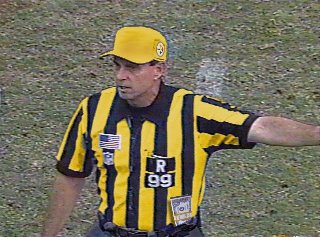
There you have it. The conspiracy theory holds up!
I found this picture and couldn't stop laughing. I just had to share. A tip of the ol' ball cap to Brad of Happy Mills.
On Super Bowl Sunday, I watched the game like countless others, disgusted by some of the worst officiating this side of the WWE. Being as I was pulling for the Seahawks, I got a little tired of the calls which usually seemed to benefit Pittsburgh. The next day I heard the many complaints that the referees were favoring the Steelers, including a few verbal jabs from Seattle's head coach. Of course, I just brushed those comments off as the ravings of disappointed fans and deranged lunatics.
That was before I saw a tape of the game and noticed something rather unusual. In view of this new evidence, I think there may be something to the charge of biased officiating in the Super Bowl. Maybe the refs actually were for the Steelers. See what you think:

There you have it. The conspiracy theory holds up!
I found this picture and couldn't stop laughing. I just had to share. A tip of the ol' ball cap to Brad of Happy Mills.
Monday, February 13, 2006
Bearing His Name
Flipping through the radio pre-sets today, I happened across Rush Limbaugh. Now I'll tell you up front that I don't enjoy listening to Limbaugh. Mostly it's because of his gargantuan ego, or at least the egotisical attitude he presents on his program. It also has something to do with the constant political bickering of which I've become so incredibly sick, that is part and parcel of his remarks. Even when I agree with him, I don't like doing it. Ever have that problem?
Anyway, I hit Rush's show just as he was taking a call -- a man complaining about something Limbaugh had said at the outset of the program. The caller's purpose was to chew out Limbaugh for bringing up an event from 35 years previous. But what caught my attention was the mode of attack. He told Rush something to the effect of, "You call yourself a Christian, but you're not acting like one." Then he asked point blank: "Are you a Christian?"
After a long pause, Limbaugh mumbled around and turned the question back on the caller. "What about you? Are you a Christian?"
Now I was a little surprised that Limbaugh simply ducked the question. I expected him to give some sort of lip service to his faith, but he avoided taking the name, "Christian." But I waited to hear what the indignant caller was going to say.
"Well, I was raised Catholic, and I try to follow the teachings of Jesus. I don't agree with all..."
"Well we all try to follow the teachings of Jesus, or Allah, or whoever," Limbaugh interrupted. From there the conversation degenerated into the same old political tripe, so I switched the station.
As I thought back over that brief snippet of the program, I realized that I had heard two people claiming to be moral and upright who couldn't bring themselves to call themselves "Christian". Each wanted to express his own claim on religion and spirituality, but neither had the intestinal fortitude to bear His name. They had no problem with Jesus as a general moral principle, but didn't want all the perceived negatives of Jesus' teachings tied to them.
I understand why it can be intimidating to bear the name of Christ. He was perfect. We are not. Many people can't move beyond that. If we represent the Perfect One, shouldn't we also be perfect? It would be nice, wouldn't it? But it's not happening. The sanctification process won't be complete this side of heaven. So there is a logical perception problem for many people. Christians are labelled as hypocrites because we can't live up to what we desire.
But beyond that issue, the name "Christian" seems to have taken on so much baggage that being a nominal Christian isn't as appealing as it used to be. Being a Christian now means being intolerant, hateful, homophobic, stuck-in-the-past, ignorant, AND hypocritical. At least that's the way many see us. It's become bad enough that some can try to follow what Jesus taught -- at least the parts they can agree with -- but never want to be associated with being a Christian.
Do we even want to change that perception? Having fewer Christians-in-name-only dragging Christ's name through the mud by their actions might ease some of the false charges made against those who bear His name. But how are we representing our Lord?
The Gospel is certainly an offense. Jesus' teachings aren't meant to make us feel good or important. He doesn't promise us the respect of the world. Being a Christian doesn't make one's problems go away. It's so much more self-gratifying to take what we want from the Bible or from the Church and toss the rest away. Why not use the name of Christ at our convenience and don't worry about Him the rest of the time? Pray only when you have a problem. Pull out the Bible and dust it off if you want to impress someone with your spirituality. Express your respect for Jesus, but claim that the Church has so corrupted His teachings that we are better off interpreting His words for ourselves. And above all, refuse to call ourselves Christians if we are asked directly.
I am not ashamed of the gospel, because it is the power of God for the salvation of everyone who believes: first for the Jew, then for the Gentile. For in the gospel a righteousness from God is revealed, a righteousness that is by faith from first to last, just as it is written: "The righteous will live by faith." - 1 Corinthians 1:16-17.
If anyone is ashamed of me and my words, the Son of Man will be ashamed of him when he comes in his glory and in the glory of the Father and of the holy angels. - Luke 9:26.
So do not be ashamed to testify about our Lord, or ashamed of me his prisoner. But join with me in suffering for the gospel, by the power of God... - 2 Timothy 1:8.
However, if you suffer as a Christian, do not be ashamed, but praise God that you bear that name. - 1 Peter 4:16.
"Lord, don't ever let me be half-hearted about bearing Your precious Name."
Anyway, I hit Rush's show just as he was taking a call -- a man complaining about something Limbaugh had said at the outset of the program. The caller's purpose was to chew out Limbaugh for bringing up an event from 35 years previous. But what caught my attention was the mode of attack. He told Rush something to the effect of, "You call yourself a Christian, but you're not acting like one." Then he asked point blank: "Are you a Christian?"
After a long pause, Limbaugh mumbled around and turned the question back on the caller. "What about you? Are you a Christian?"
Now I was a little surprised that Limbaugh simply ducked the question. I expected him to give some sort of lip service to his faith, but he avoided taking the name, "Christian." But I waited to hear what the indignant caller was going to say.
"Well, I was raised Catholic, and I try to follow the teachings of Jesus. I don't agree with all..."
"Well we all try to follow the teachings of Jesus, or Allah, or whoever," Limbaugh interrupted. From there the conversation degenerated into the same old political tripe, so I switched the station.
As I thought back over that brief snippet of the program, I realized that I had heard two people claiming to be moral and upright who couldn't bring themselves to call themselves "Christian". Each wanted to express his own claim on religion and spirituality, but neither had the intestinal fortitude to bear His name. They had no problem with Jesus as a general moral principle, but didn't want all the perceived negatives of Jesus' teachings tied to them.
I understand why it can be intimidating to bear the name of Christ. He was perfect. We are not. Many people can't move beyond that. If we represent the Perfect One, shouldn't we also be perfect? It would be nice, wouldn't it? But it's not happening. The sanctification process won't be complete this side of heaven. So there is a logical perception problem for many people. Christians are labelled as hypocrites because we can't live up to what we desire.
But beyond that issue, the name "Christian" seems to have taken on so much baggage that being a nominal Christian isn't as appealing as it used to be. Being a Christian now means being intolerant, hateful, homophobic, stuck-in-the-past, ignorant, AND hypocritical. At least that's the way many see us. It's become bad enough that some can try to follow what Jesus taught -- at least the parts they can agree with -- but never want to be associated with being a Christian.
Do we even want to change that perception? Having fewer Christians-in-name-only dragging Christ's name through the mud by their actions might ease some of the false charges made against those who bear His name. But how are we representing our Lord?
The Gospel is certainly an offense. Jesus' teachings aren't meant to make us feel good or important. He doesn't promise us the respect of the world. Being a Christian doesn't make one's problems go away. It's so much more self-gratifying to take what we want from the Bible or from the Church and toss the rest away. Why not use the name of Christ at our convenience and don't worry about Him the rest of the time? Pray only when you have a problem. Pull out the Bible and dust it off if you want to impress someone with your spirituality. Express your respect for Jesus, but claim that the Church has so corrupted His teachings that we are better off interpreting His words for ourselves. And above all, refuse to call ourselves Christians if we are asked directly.
I am not ashamed of the gospel, because it is the power of God for the salvation of everyone who believes: first for the Jew, then for the Gentile. For in the gospel a righteousness from God is revealed, a righteousness that is by faith from first to last, just as it is written: "The righteous will live by faith." - 1 Corinthians 1:16-17.
If anyone is ashamed of me and my words, the Son of Man will be ashamed of him when he comes in his glory and in the glory of the Father and of the holy angels. - Luke 9:26.
So do not be ashamed to testify about our Lord, or ashamed of me his prisoner. But join with me in suffering for the gospel, by the power of God... - 2 Timothy 1:8.
However, if you suffer as a Christian, do not be ashamed, but praise God that you bear that name. - 1 Peter 4:16.
"Lord, don't ever let me be half-hearted about bearing Your precious Name."
Saturday, February 11, 2006
Just Doing My Duty
Imagine yourself on a sunny Tuesday morning. It's September, but the picture around you still looks like summer -- only without the unbearable heat and humidity. You are on the job. Working your shift to earn your pay. Just doing your duty.
As someone who responds to emergencies, when a call comes in, you respond. Simple as that. So when the call comes in on that beautiful September day, you get in the vehicle and head into what could certainly be trouble. But that isn't the point. No matter what awaits, you have a job to do; a duty to perform.
That was the situation which many firefighters and police officers found themselves in back on a sunny Tuesday morning in September of 2001. People were in trouble and it was the job of the emergency personnel to help them out. In return for "just doing their duty" many lost their lives, more still live with the nightmarish memory of what happened on September 11th in New York City. We've called these people heroes because they gave of themselves. And while I'll agree that people who work as firefighters and police officers and ambulance drivers and emergency medical personnel are doing the work of heroes, to those in those positions they are simply doing their job. I doubt that any of the men and women who rushed up the stairs of the World Trade Center buildings that morning was thinking about being called a hero. They were just doing their duty.
Jesus posed an interesting question concerning the way someone is treated who is just doing their duty. He couched it in terms which were easily understood in His day, but hard to grasp in ours. Jesus said:
I remember when Baltimore Oriole Cal Ripken, Jr. broke the record for consecutive games played, formerly held by Yankee great, Lou Gerhig. A lot of pomp and circumstance surrounded Ripken's every game, waiting until the streak hit 2131 games. When it did, the stadium exploded in an ovation which lasted for 22 minutes. Ripken himself though, always felt funny about being hailed in such a way. After all, he was just showing up for work every day.
At my kids' school, there is an incentive program to promote good behavior in school. If a kid can manage not to get into trouble more than three times in nine weeks, they are given a reward -- usually a field trip or a pizza party or the like. Let me rephrase this: if they do what they are supposed to do -- behave while in school -- they get rewarded! This is not for going beyond the call. This is for doing what they are supposed to be doing in the first place! They have it backwards. The reward for being good is not getting into trouble, just like the reward for doing your job is not getting fired. But today we seem to feel that we should be recognized for doing our duty. We love those rewards. They owe us! I know my kids' school is tame as far as the whole reward good behavior movement is concerned. I heard someone on the radio this week talking about a school in California where all the kids with perfect attendance for the year were given the chance to win a new Mustang convertable! How could anyone ever expect to deserve that kind of prize just for showing up in class every day?
We can complain about all we want but if we are honest, we know from experience that even a fine upstanding Christian person usually looks for a reward for doing our Christian duty. C'mon. You know. That feeling of expectation deep inside wondering why no one has publically thanked you for teaching the Junior High Sunday School class for the past three years. That disappointment you feel when nobody mentions it when you go out of your way to distribute church bulletins to everyone, but the one person you miss complains long and loud to everyone. We love our acclaim, our public thanks, the compliments on a job well done just as much as the Pharisees loved to get the good seats and receive the respect of the people. And we remember what Jesus had to say about them.
Church fund raising experts say that if a church wants to increase giving from the congregation, it needs to effusively thank each giver and personally recognize them for every last gift he or she has given to the church. It may be effective, but it's nonsense. As a Christian it's my duty to support God's work through the local church, and I'm to do that without looking for a thank you card, a public show of appreciation or a tax deduction. You see, I owe God much more than what I can give. I shouldn't be giving or serving just so I can feel appreciated.
I've taken far too long to explain what took Jesus only four verses to say. Namely that we are called to obedience as Christians. We are to serve Christ -- not for the acclaim or the reputation or the restaurant gift certificate given as a thank you -- we serve because that is our duty. If we feel sleighted because we are never rewarded, get over yourself. You don't deserve a reward. You're not special. You're just doing your duty.
As Christians, we were bought at a price. That price was the blood of Jesus Christ. Being a Christian means we are not owed, we are owned. Our service is simply our duty to our Master. Our duty is obedience to Him who owns us.
As someone who responds to emergencies, when a call comes in, you respond. Simple as that. So when the call comes in on that beautiful September day, you get in the vehicle and head into what could certainly be trouble. But that isn't the point. No matter what awaits, you have a job to do; a duty to perform.
That was the situation which many firefighters and police officers found themselves in back on a sunny Tuesday morning in September of 2001. People were in trouble and it was the job of the emergency personnel to help them out. In return for "just doing their duty" many lost their lives, more still live with the nightmarish memory of what happened on September 11th in New York City. We've called these people heroes because they gave of themselves. And while I'll agree that people who work as firefighters and police officers and ambulance drivers and emergency medical personnel are doing the work of heroes, to those in those positions they are simply doing their job. I doubt that any of the men and women who rushed up the stairs of the World Trade Center buildings that morning was thinking about being called a hero. They were just doing their duty.
Jesus posed an interesting question concerning the way someone is treated who is just doing their duty. He couched it in terms which were easily understood in His day, but hard to grasp in ours. Jesus said:
Suppose one of you had a servant plowing or looking after the sheep. Would he say to the servant when he comes in from the field, "Come along now and sit down to eat"? Would he not rather say, "Prepare my supper, get yourself ready and wait on me while I eat and drink; after that you may eat and drink"? Would he thank the servant because he did what he was told to do?The Master is pointing out something very basic, but often overlooked. A person doesn't deserve a reward for doing what he is supposed to be doing all along. If he gets one, fine, but he shouldn't expect a bonus for fulfilling his obligation. That's what duty is, after all. An obligation. If I am being paid to plow a field, then why would I expect to finish and have my employer rush out to me, thank me profusely and then offer to take me out for a steak dinner? I just did what I was supposed to do... what I was paid to do... what I agreed to do when I took the job.

I remember when Baltimore Oriole Cal Ripken, Jr. broke the record for consecutive games played, formerly held by Yankee great, Lou Gerhig. A lot of pomp and circumstance surrounded Ripken's every game, waiting until the streak hit 2131 games. When it did, the stadium exploded in an ovation which lasted for 22 minutes. Ripken himself though, always felt funny about being hailed in such a way. After all, he was just showing up for work every day.
At my kids' school, there is an incentive program to promote good behavior in school. If a kid can manage not to get into trouble more than three times in nine weeks, they are given a reward -- usually a field trip or a pizza party or the like. Let me rephrase this: if they do what they are supposed to do -- behave while in school -- they get rewarded! This is not for going beyond the call. This is for doing what they are supposed to be doing in the first place! They have it backwards. The reward for being good is not getting into trouble, just like the reward for doing your job is not getting fired. But today we seem to feel that we should be recognized for doing our duty. We love those rewards. They owe us! I know my kids' school is tame as far as the whole reward good behavior movement is concerned. I heard someone on the radio this week talking about a school in California where all the kids with perfect attendance for the year were given the chance to win a new Mustang convertable! How could anyone ever expect to deserve that kind of prize just for showing up in class every day?
We can complain about all we want but if we are honest, we know from experience that even a fine upstanding Christian person usually looks for a reward for doing our Christian duty. C'mon. You know. That feeling of expectation deep inside wondering why no one has publically thanked you for teaching the Junior High Sunday School class for the past three years. That disappointment you feel when nobody mentions it when you go out of your way to distribute church bulletins to everyone, but the one person you miss complains long and loud to everyone. We love our acclaim, our public thanks, the compliments on a job well done just as much as the Pharisees loved to get the good seats and receive the respect of the people. And we remember what Jesus had to say about them.
Church fund raising experts say that if a church wants to increase giving from the congregation, it needs to effusively thank each giver and personally recognize them for every last gift he or she has given to the church. It may be effective, but it's nonsense. As a Christian it's my duty to support God's work through the local church, and I'm to do that without looking for a thank you card, a public show of appreciation or a tax deduction. You see, I owe God much more than what I can give. I shouldn't be giving or serving just so I can feel appreciated.
I've taken far too long to explain what took Jesus only four verses to say. Namely that we are called to obedience as Christians. We are to serve Christ -- not for the acclaim or the reputation or the restaurant gift certificate given as a thank you -- we serve because that is our duty. If we feel sleighted because we are never rewarded, get over yourself. You don't deserve a reward. You're not special. You're just doing your duty.
As Christians, we were bought at a price. That price was the blood of Jesus Christ. Being a Christian means we are not owed, we are owned. Our service is simply our duty to our Master. Our duty is obedience to Him who owns us.
I Must Have Really Messed Up on THIS Quiz...
| You Should Get a MFA (Masters of Fine Arts) |
 You're a blooming artistic talent, even if you aren't quite convinced. You'd make an incredible artist, photographer, or film maker. |
I'm not even close to convinced. Arts, perhaps... fine arts, nope. Dining, yes... fine dining, no. Fine wine, no. Fine hair, no. OK, how 'bout... hair, no.
(A tip of the ol' ballcap to Kim.)
Subscribe to:
Posts (Atom)
